Solid State Batteries: The Future of Energy Storage
Solid State Batteries: The Future of Energy Storage Solid state batteries are a type of rechargeable battery that has a solid electrolyte instead of a liquid one, as in traditional lithium-ion batteries. This new technology has the potential to revolutionize the way we store and use energy. Here are some key benefits and potential applications of solid state batteries: Higher Energy Density: The solid electrolyte allows for a higher packing density of active materials, leading to more energy storage per unit volume. Improved Safety: The absence of flammable liquid electrolyte reduces the risk of fire or explosion, making solid state batteries safer for use in devices such as electric vehicles and smartphones. Longer Life Span: The solid electrolyte also reduces the rate of degradation, potentially extending the lifespan of the battery. Faster Charging: The reduced ionic resistance of the solid electrolyte allows for faster charging times compared to traditional batteries. Wider Operating Temperature Range: Solid state batteries can function in a wider range of temperatures, making them suitable for use in a variety of environments. Potential applications of solid state batteries include electric vehicles, consumer electronics, grid-scale energy storage systems, and aerospace. However, the technology is still in its early stages of development, and there are several challenges that need to be overcome before widespread commercialization can occur. These include the need for more efficient and cost-effective production methods, and the development of durable and stable solid electrolytes. Solid state batteries represent a promising technology with the potential to transform the energy storage landscape. While there is still much work to be done, the benefits of this technology make it a promising candidate for future energy storage solutions.
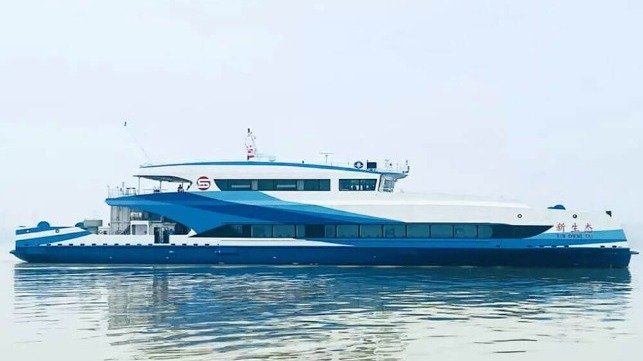
China Working On Supercapacitor-Powered Ferry
CSSC tested the first ferry employing supercapacitor batteries (CSSC) PUBLISHED NOV 22, 2021 6:30 PM BY THE MARITIME EXECUTIVE Chinese shipbuilder CSSC is reporting the first successful sea trials for a ferry employing a pure supercapacitor in its power system. It would be one of the world’s first commercial applications of the highly efficient power system which would hold the potential to greatly enhance electric power vessels. In announcing the breakthrough, CSSC said that its proprietary research division, 711 Research Institute used DC network electric propulsion technology, energy storage control technology, and smart ship applications to develop the propulsion system. Among the advantages of a supercapacitor system will be short recharging periods, slow power release with greater efficiency to provide for longer cycle times, and more efficient operations. The fully electric propulsion will also greatly reduce vibration and noise to produce a more comfortable ride for passengers. The ferry, Xin Ecology, measures 213 feet in length and is outfitted with two sets of supercapacitor batteries which they reported have a total energy storage capacity of 625kWh. The output power will be 2000 kilowatts providing the vessel with a speed of 12 knots. The engineers and scientists report the system will be able to support a minimum of 200,000 power cycles. The fast recharges and long cycle times will save about 500 tons of fuel per year. Operation of the ferry will be supported with a 2.5 MW DC shore power station. It will provide for the recharging of the supercapacitor batteries, although they did not indicate how often the recharging would be required. CSSC is also reporting that it is the world’s largest passenger ferry equipped with azimuth propellers. The use of the azimuth propellers/rudders they said gives the vessel a higher degree of maneuverability, improving the turning performance over conventional ferries. The ferry is expected to enter service at the end of the year operating in the area near Shanghai. Special attention was also given to the strength and height of the vehicle deck for the vessel. It reportedly can accommodate tourist buses as well as large trucks with passengers in a separate lounge area on the same deck.
Toyota develops fuel cell system for maritime applications
Specially designed Fuel Cell System to be delivered to Energy Observer Project successfully demonstrates adaptability of the Toyota fuel cell technology February 3, 2020―Former racing catamaran turned ship of the future, Energy Observer has made waves as it has been navigating its six-year odyssey around the world as the first energy-autonomous hydrogen vessel. Today, Toyota, official partner of Energy Observer and an avid supporter of their project from the start, announces that it has developed a fuel cell system for maritime applications, with its first delivery destined for Energy Observer. Embarking in June 2017 from Saint- Malo Port in France, Energy Observer is an electrically propelled vessel of the future that is operated using a mix of renewable energies and an on-board system that produces carbon-free hydrogen from seawater. The operators of the vessel are on a mission to go and meet people in 50 countries and 101 ports during their voyage who are designing the future, with an aim to prove that a cleaner world is not only possible, but that the innovations can open some doors to a new economic expansion. Their activities also demonstrate and share potential solutions to champion an ecological and energy transition, as well as support tomorrow's energy networks as they encourage providers to make the networks more efficient and applicable on a large scale. Previously, Toyota's fuel cell system, which was first introduced in the Toyota Mirai, the world's first mass-produced hydrogen fuel cell electric vehicle, proved its value as a propulsion system for automobiles. However, the company has more recently been exploring the use of its fuel cell system in other applications such as buses and trucks. Toyota, a company aiming to develop a hydrogen society based on its challenge to "Establish a future society in Harmony with Nature" as stated in its Environmental Challenge 2050, was able to align with Energy Observer.'s mission and activities. From that common ground, the two have worked closely together on how a hydrogen fuel cell system could be adapted to martime applications, which eventually led to the introduction of Toyota's maritime fuel cell technology and system. The maritime-specific fuel cell system was developed by Toyota Technical Center Europe in a mere seven months. It required a re-design of the system, followed by the build and installation of the compact fuel cell module. This was accomplished using components first introduced in the Toyota Mirai which were fitted into a more compact module suitable for marine applications. The project successfully demonstrates the adaptability of the Toyota fuel cell technology to a variety of applications, including those outside of land-based vehicles. "We are very proud to embark the Toyota Fuel Cell System on our oceans passages, and test it in the roughest conditions. After three years and nearly 20 000 nautical miles of development, the Energy Observer energy supply and storage system is now very reliable and we look forward to the next step of the project : Get a reliable and affordable system available for our maritime community. We believe that the Toyota Fuel Cell System is the perfect component for this, industrially produced, efficient and safe. Being an ambassador for the Sustainable Development Goals (SDGs), our mission is to promote clean energy solutions and we share with Toyota the same vision for a hydrogen society." Victorien Erussard, founder and captain of Energy Observer The Toyota Fuel Cell System has proven its benefits already for many years in the Mirai, but more recently also in other applications such as buses and trucks. Using it for maritime transportation is again another step closer to the development of the hydrogen society. Toyota believes that hydrogen is the catalyst for energy decarbonisation and the technology acceptance can accelerate with the Toyota Fuel Cell System modular solution, which can be considered for a multitude of applications. "We are pleased to be able to further demonstrate the versatility of the Toyota Fuel Cell System. Our European R&D team has worked hard with the team of the Energy Observer to create and install this module in the existing boat. This project shows that the Toyota Fuel Cell technology can be used in any environment and can be spread throughout many business opportunities. It is always inspiring to work with people who aim for the same goals and this project supports even more our vision for a hydrogen society." Dr Johan van Zyl, President and CEO of Toyota Motor Europe To ensure compatibility, the Toyota fuel cell module was tested with Energy Observer while the boat was at dock at the end of last year. Currently, the system is undergoing its final full power testing is at sea prior to the Energy Observer officially setting sail from Saint- Malo Port, scheduled in Feburary, as they embark for their 2020 Tour. Energy Observer is set to benefit from the Toyota maritime fuel cell system capable of delivering more power, efficiency, and reliability as its tour route includes crossing both the Atlantic and Pacific Oceans. Overview of the boathttp://www.energy-observer.org/en/#bateau Length 31m Width 13m Weight 34 tons Height 12.85m Draft 2.2m Crew members 8 Average Speed 4/5 knots (electricity), 8 knots (polpulsive wings) Energy Observer, the first French ambassador for the Sustainable Development Goals (SDG),has visited 25 countries, 48 ports and cruising range has reached approximately 18,000 nautical miles for 3 years. Energy Observer partnershttp://www.energy-observer.org/en/partenaires.php#partenaires Download ZIP PDF
SYDNEY FESTIVAL OF BOATING CANCELLED
SYDNEY FESTIVAL OF BOATING CANCELLED The Boating Industry Association (BIA) has cancelled the Sydney Festival of Boating, which was scheduled to run from 29 July to 1 August, to support efforts by government in controlling the current COVID-19 outbreak in Sydney which is now impacting other States. The BIA will now focus its attention on promoting the boating lifestyle in the run up to the next boating season through programs such as its Discover Boating initiative supported by a multi-media marketing campaign. Boating has proven to be a standout choice in leisure activity through the pandemic. The combination of no international travel, the staycation phenomenon, flexible work practices and the need to be COVID Safe have seen interest in getting out the water ramp up significantly.